 飞行邦网
飞行邦网 微信关注,获取更多
 长度:332.8米(1.092英尺)- 总长 / 317米(1.040英尺)- 水线长
船宽:76.8米(252英尺)- 总宽 / 40.8米(134英尺)- 水线宽
吃水深度:11.3米(37英尺)
速度:30节以上(56公里/小时以上)
推进系统:
2座西屋A4W核反应堆(260000马力/194兆瓦)
4台汽轮机
4个轴/4个螺旋桨
范围:无限制/20-25年
载员:3500(舰载)/2480(空中联队)
武器装备:
(各船情况不同)
2-3套Mk.29发射器,用于发射8枚RIM-7“海麻雀”舰空导弹或8枚RIM-162“改进型海麻雀”导弹(ESSM)
2套Mk.49导弹发射系统,用于发射21枚RIM-116滚体导弹(RAM)
3-4套Mk.15“密集阵”近程武器系统(CIWS)
Mk.38机枪系统
航空:
配备舰岛和机库甲板的完整飞行甲板
最多可容纳90架飞机
系统:
AN/SPS-48E电子扫描阵列三维空中搜索雷达
AN/SPS-49远程二维空中搜索雷达
AN/SPQ-9目标截获雷达
AN/SPN-46精确进场着陆系统
AN/SPN-43C二维空中交通管制雷达
AN/SPN-41着陆辅助雷达
4套Mk.91制导系统/4套Mk.95火控雷达(海麻雀)
AN/SLQ-32A电子战套件
SLQ-25A 尼克斯拖曳式鱼雷诱饵
| 美国哈里·S·杜鲁门号航空母舰(CVN 75) 罗纳德·里根号航空母舰(CVN 76号) 乔治·h·w·布什号航空母舰(CVN 77号) 美国约翰·C·斯坦尼斯号航空母舰(CVN 74) |
这些船只最初的一个主要目的是在冷战期间支持美国军队,它们被设计成具有用于这一角色的能力,包括在蓝水部署时使用核动力而不是石油来获得更大的续航能力,以及根据新的情报和技术发展来调整航母武器系统的能力。它们最初只被归类为攻击航母,但从卡尔·罗宇胜号开始,它们就被建造成具有反潜能力。因此,这些船只和它们的飞机现在能够参与广泛的行动,包括海上和空中封锁、布雷以及对陆地、空中和海上的导弹打击。| 由于设计上的缺陷,当战斗载荷超过了他们的横倾控制系统的能力时,这一级别的船有固有的右舷横倾。这个问题似乎在一些更现代的船只上特别普遍。这个问题以前已经通过使用压载物的损害控制空隙来纠正,但是已经提出了使用固体压载物的解决方案,其不影响船的生存能力。| 建筑:| 所有10艘尼米兹级航空母舰都是在1968年至2006年间在弗吉尼亚州纽波特纽斯的纽波特纽斯造船公司建造的,该公司位于西半球最大的干船坞12号干船坞,在最近的扩建后,现在有2172英尺(662米)长。| 从西奥多·罗斯福号航空母舰开始,航空母舰就采用模块化结构制造(布什号航空母舰号由161个“超级升力”模块组成)。这意味着整个部分可以与已经安装的管道和电气设备焊接在一起,从而提高效率。使用龙门起重机,模块被吊入干船坞并焊接。就船首部分而言,它们的重量超过150万磅(680吨)。这种方法最初是由英格尔斯造船公司开发的,它提高了工作效率,因为许多装配工作不必在已经完成的船体范围内进行。
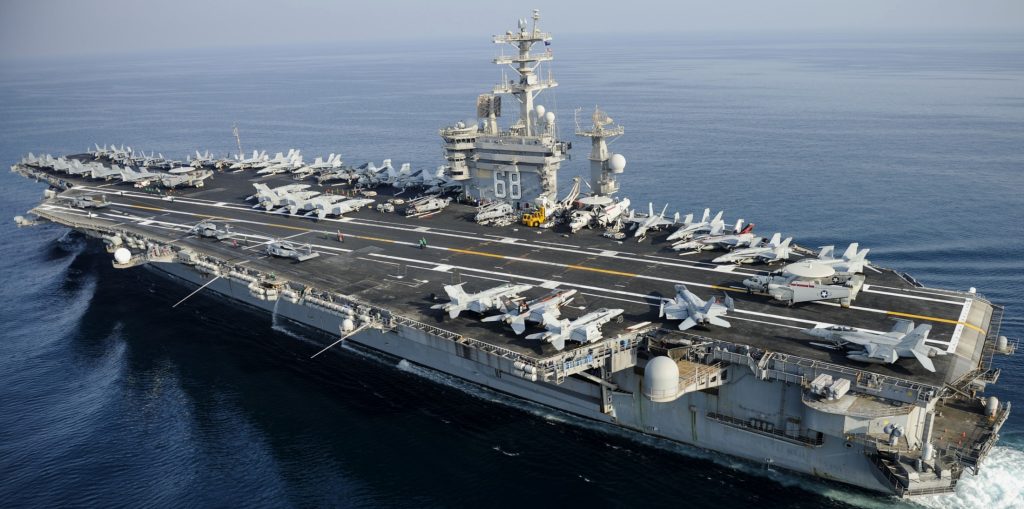
该级别的所有船只都由两个A4W核反应堆提供动力,分别存放在不同的舱室中。它们为四个传动轴提供动力,最大速度超过30节(56公里/小时),最大功率为260.000 bhp (190 MW)。反应堆通过加热水的核裂变产生热量。然后通过两个反应堆共用的四个涡轮机(由通用电气公司制造)。涡轮机为四个青铜螺丝提供动力,每个螺丝的直径为25英尺(7.6米),重量为66.000磅(30吨)。在这些后面是两个方向舵,高29英尺(8.8米),长22英尺(6.7米),每个重110.000磅(50吨)。自罗纳德·里根号航母以来建造的尼米兹级航母也有球鼻艏,以通过减少兴波阻力来提高速度和燃油效率。由于使用了核动力,这些船只能够在不补充燃料的情况下连续运行20多年,预计使用寿命超过50年。
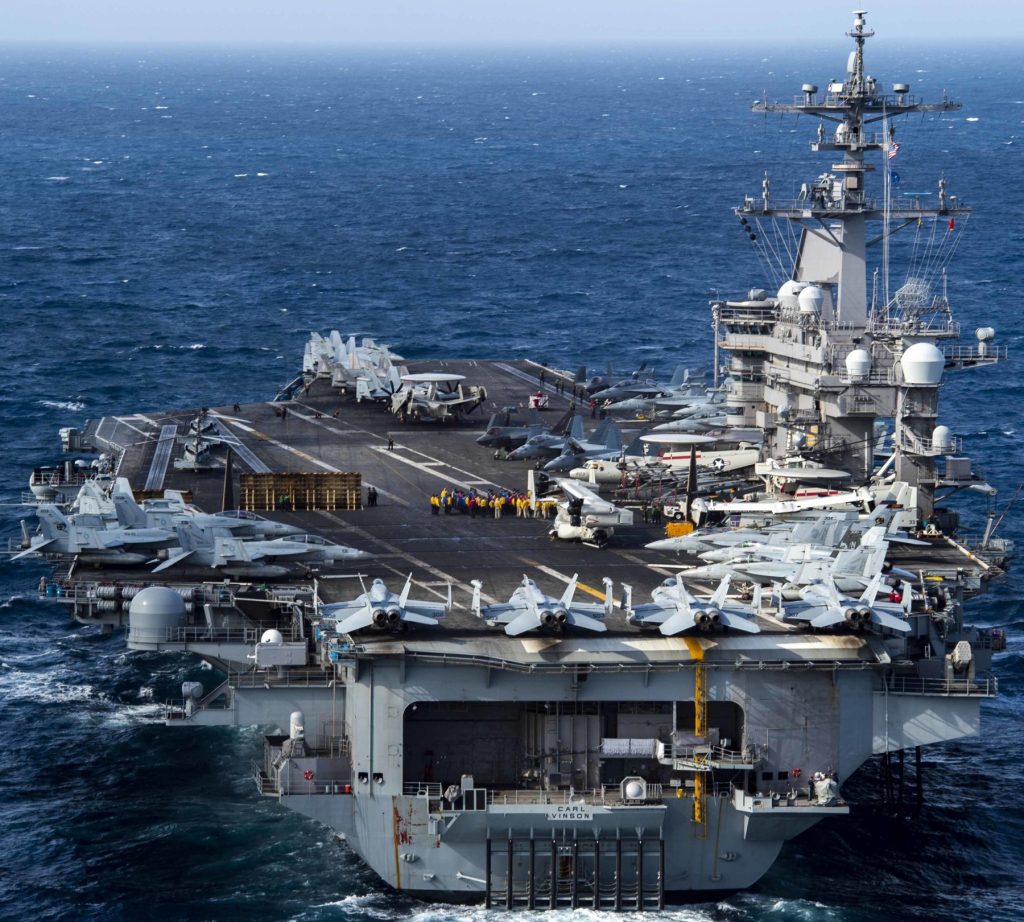
除了船上携带的飞机,船只还携带防御设备,用于对付导弹和敌机。这些包括三个或四个北约RIM-7海雀导弹发射器,用于防御飞机和反舰导弹,以及三个或四个20毫米方阵CIWS导弹防御炮。罗纳德·里根号航空母舰没有这些,建造了RIM-116滚动机体导弹系统,其中两个还安装在尼米兹号航空母舰和乔治·华盛顿号航空母舰上。这些将安装在其他船只上,当他们返回加油和复杂的检修(RCOH)。自西奥多·罗斯福号航空母舰以来,航空母舰的重要部位都采用了2.5英寸(64毫米)的凯夫拉尔装甲,早期的船只也采用了这种装甲:1983-1984年的尼米兹号,1985-1987年的艾森豪威尔号和1989年的罗宇胜号。
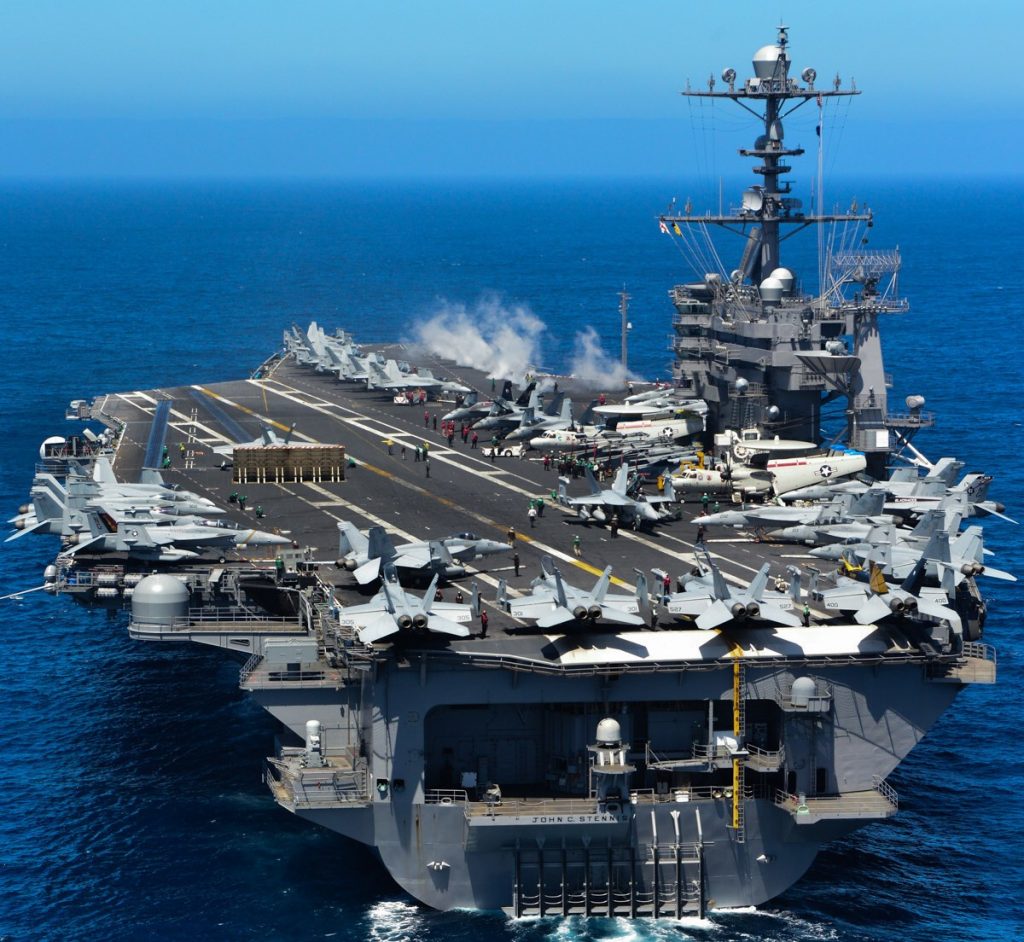
自冷战结束以来,美国航空母舰上存在核武器,美国政府既没有证实也没有否认。由于这一点,以及对核电安全的担忧,美国航空母舰在外国港口的存在偶尔会引发当地人的抗议,例如2007年美国海军尼米兹号(USS Nimitz)停靠在印度钦奈时。当时,攻击群指挥官少将·约翰·特伦斯·布雷克说:“美国的政策是,我们不在尼米兹号上例行部署核武器。” 2013年5月,老布什(George H.W. Bush)进行了水面舰艇鱼雷防御系统(SSTDS)的首次舰载端到端海上测试。SSTDS将鱼雷预警系统(TWS)的被动探测与反鱼雷(CAT)的硬杀伤能力相结合,反鱼雷是一种封装的微型鱼雷,旨在定位、瞄准并摧毁敌方鱼雷。这增加了对尾流自导鱼雷的防护,如53型鱼雷对声诱饵没有反应。SSTDS的部件被设计用来在几秒钟内定位并摧毁来袭的鱼雷。每个系统包括一只TWS和8只猫。初始作战能力(IOC)计划在2019年完成,所有航空母舰将在2035年完成装备。
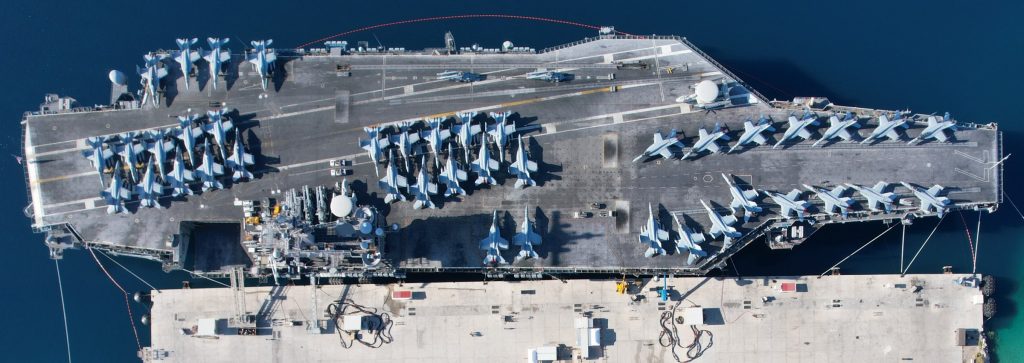
舰载机联队(CVW): 为了让航空母舰展开,它必须搭载十个航空母舰航空联队中的一个(CVW)。这些航空母舰最多可以容纳130架F/A-18大黄蜂或85-90架不同类型的飞机,但目前的数量通常为64架。虽然空军联队与他们部署到的航空母舰的运作是一体的,但他们仍然被视为一个独立的实体。除了空勤人员,空军联队也由后勤人员组成,他们的职责包括维护、飞机和军械处理以及应急程序。飞行甲板上的每个人都穿着不同颜色的衣服,以便于识别自己的角色。
一个典型的舰载机联队可以包括24-36架F/A-18E或F超级大黄蜂作为攻击战斗机;两个中队10-12架F/A-18C大黄蜂,其中一架通常由美国海军陆战队(VMFA)提供,也作为攻击战斗机;电子战用4-6架EA-18G咆哮者;4-6架E-2C或D鹰眼用于空中预警(AEW),C-2灰狗用于后勤(将被MV-22鱼鹰取代);以及一个由6-8架SH-60F和HH-60H海鹰组成的直升机反潜中队。以前从尼米兹级航空母舰操作的飞机包括F-4幻影,RA-5C义警,RF-8G十字军,F-14雄猫,S-3维京,A-7海盗船II和A-6E入侵者飞机。
飞行甲板呈九度角,这使得飞机可以同时发射和回收。与以前的航母相比,飞行甲板的角度略有减小,因为当前的设计改善了航母周围的气流。四个蒸汽弹射器用于发射固定翼飞机,四个拦阻索用于回收。两艘最新的航母,罗纳德·里根号和乔治H.W布什号,每艘都只有三根拦阻索,因为第四根在早期的船只上很少使用,因此被认为是不必要的。与较小的航空母舰相比,这种CATOBAR布置允许更快的发射和回收,以及更广泛的可以在船上使用的飞机,较小的航空母舰大多数使用更简单的STOVL布置,没有弹射器或拦阻索。该船的飞机操作是由空中老板从主要飞行控制或Pri-Fly控制的。四部大型升降机在飞行甲板和下面的机库之间运送飞机。这些飞机库被设计用来限制火势蔓延的厚钢门分成三个隔间。
虽然最后七艘航母(从西奥多·罗斯福号开始)的设计与早期的略有不同,但美国海军将所有十艘航母视为一个级别。当较老的航空母舰来加油和进行复杂的检修时(RCOH),它们的核电站会被加油,并升级到较新的航空母舰的标准。可以进行其他修改来更新船上的设备。这些船只最初只被归类为攻击航母,但自卡尔·罗宇胜号航空母舰以来就已经建造了反潜能力。这些改进包括更好的雷达系统和设施,使舰船能够在更有效的反潜战中操作飞机,包括安装通用海底图像(CUP)技术,该技术使用声纳来更好地评估潜艇的威胁。变化包括更好地支持S-3维京ASW巡逻机和SH-60F海鹰直升机的吊放声纳系统。 西奥多·罗斯福号航空母舰和后来的航空母舰与早期的尼米兹号航空母舰在结构上略有不同,比如对储存在弹匣中的军械的保护有所改进。其他改进包括升级飞行甲板弹道保护,首次安装在乔治华盛顿号航空母舰上,以及从约翰·C·斯坦尼斯号航空母舰开始用于建造船只的高强度低合金钢(HSLA-100)。最近,旧船的飞行甲板已经升级,在新造的船上安装了新的防滑材料,以提高船员和飞机的安全性。 (1989)
该级的最后一艘航空母舰“布什号航空母舰”号被设计成从尼米兹级到替换的杰拉尔德·福特级的“过渡舰”。布什号采用了新技术,包括改进的螺旋桨和球鼻艏设计、缩小的雷达截面以及电子和环境升级。结果,这艘船的造价为62亿美元。早期的尼米兹级战舰每艘造价约45亿美元。为了降低成本,一些新技术和设计特点也被纳入前航母罗纳德·里根号,包括重新设计的岛屿。
The Nimitz-class aircraft carriers were ordered to supplement the aircraft carriers of the Kitty Hawk class and Enterprise class, maintaining the strength and capability of the U.S. Navy after the older carriers were decommissioned. The ships were designed to be improvements on previous U.S. aircraft carriers, in particular the Enterprise and Forrestal-class supercarriers, although the arrangement of the ships is relatively similar to that of the Kitty Hawk class. Among other design improvements, the two reactors on Nimitz-class carriers take up less space than the eight reactors used on Enterprise. Along with a more generally improved design, this means that Nimitz-class carriers can carry 90% more aviation fuel and 50% more ordnance when compared to the Forrestal class.
尼米兹级航空母舰被订购以补充小鹰级和企业级的航空母舰,在老旧航母退役后维持美国海军的实力和能力。这些舰艇的设计是对美国以往航空母舰的改进,尤其是对企业号和福里斯特尔级超级航母的改进,尽管其布局与小鹰级相对相似。除其他设计改进外,尼米兹级航母上的两个反应堆所占空间比企业号上的八个反应堆要小。除了设计上的普遍改进外,这意味着与福里斯特尔级相比,尼米兹级航母可携带的航空燃料增加了90%,弹药增加了50%。
The U.S. Navy has stated that the carriers could withstand three times the damage sustained by the Essex class inflicted by Japanese air attacks during World War II. The hangars on the ships are divided into three fire bays by thick steel doors that are designed to restrict the spread of fire. This addition has been present on U.S. aircraft carriers since World War II, after the fires caused by Kamikaze attacks.
尼米兹级航空母舰被订购以补充小鹰级和企业级的航空母舰,在老旧航母退役后维持美国海军的实力和能力。这些舰艇的设计是对美国以往航空母舰的改进,尤其是对企业号和福里斯特尔级超级航母的改进,尽管其布局与小鹰级相对相似。除其他设计改进外,尼米兹级航母上的两个反应堆所占空间比企业号上的八个反应堆要小。除了设计上的普遍改进外,这意味着与福里斯特尔级相比,尼米兹级航母可携带的航空燃料增加了90%,弹药增加了50%。
The first ships were designed around the time of the Vietnam War, and certain aspects of the design were influenced by operations there. To a certain extent, the carrier operations in Vietnam demonstrated the need for increased capabilities of aircraft carriers over their survivability, as they were used to send sorties into the war and were therefore less subject to attack. As a result of this experience, Nimitz carriers were designed with larger stores of aviation fuel and larger magazines in relation to previous carriers, although this was partly as a result of increased space available by the new design of the ships’ propulsion systems.
首批舰船的设计大约是在越南战争期间,其设计的某些方面受到了越南作战行动的影响。从某种程度上说,越南的航母作战行动表明,除了生存能力外,还需要提高航母的能力,因为它们被用于向战场派遣飞机,因此受到的攻击较少。基于这一经验,尼米兹级航母的设计相较于之前的航母,配备了更大的航空燃料储备和更大的弹药库,尽管这在一定程度上是由于船舶推进系统的新设计提供了更多可用空间。
A major purpose of the ships was initially to support the U.S. military during the Cold War, and they were designed with capabilities for that role, including using nuclear power instead of oil for greater endurance when deployed in blue water, and the ability to make adjustments to the carriers’ weapons systems on the basis of new intelligence and technological developments. They were initially categorized only as attack carriers, but ships have been constructed with anti-submarine capabilities since USS Carl Vinson. As a result, the ships and their aircraft are now able to participate in a wide range of operations, which can include sea and air blockades, mine laying, and missile strikes on land, air and sea.
这些舰艇的主要目的最初是在冷战期间为美国军队提供支持,它们的设计具备执行这一任务的能力,包括在部署于远洋时使用核动力而非燃油以增强续航能力,以及根据新的情报和技术发展对航母的武器系统进行调整的能力。它们最初仅被归类为攻击型航母,但自“卡尔·文森”号航母以来,建造的舰艇均具备反潜能力。因此,这些舰艇及其搭载的飞机现在能够参与多种作战行动,包括海上和空中封锁、布雷以及对陆地、空中和海上的导弹打击。
Because of a design flaw, ships of this class have inherent lists to starboard when under combat loads that exceed the capability of their list control systems. The problem appears to be especially prevalent on some of the more modern vessels. This problem has been previously rectified by using damage control voids for ballast, but a solution using solid ballast which does not affect the ship’s survivability has been proposed.
Construction:
All ten Nimitz-class aircraft carriers were constructed between 1968 and 2006 at Newport News Shipbuilding Company, in Newport News, Virginia, in the largest drydock in the western hemisphere, dry dock 12. now 2.172 feet (662 m) long after a recent expansion.
Since USS Theodore Roosevelt, the aircraft carriers were manufactured in modular construction (USS George H.W. Bush was constructed from 161 ‘super-lift’ modules). This means that whole sections could be welded together with plumbing and electrical equipment already fitted, improving efficiency. Using gantry cranes, the modules were lifted into the dry dock and welded. In the case of the bow section, these can weigh over 1.500.000 pounds (680 t). This method was originally developed by Ingalls Shipbuilding and increases the rate of work because much of the fitting out does not have to be carried out within the confines of the already finished hull.
Propulsion:
All ships of the class are powered by two A4W nuclear reactors, kept in separate compartments. They power four propeller shafts and can produce a maximum speed of over 30 knots (56 km/h) and maximum power of 260.000 bhp (190 MW). The reactors produce heat through nuclear fission which heats water. This is then passed through four turbines (manufactured by General Electric) which are shared by the two reactors. The turbines power the four bronze screws, each with a diameter of 25 feet (7.6 m) and a weight of 66.000 pounds (30 t). Behind these are the two rudders which are 29 feet (8.8 m) high and 22 feet (6.7 m) long, and each weigh 110.000 pounds (50 t). The Nimitz-class ships constructed since USS Ronald Reagan also have bulbous bows in order to improve speed and fuel efficiency by reducing Wave-making resistance. As a result of the use of nuclear power, the ships are capable of operating continuously for over 20 years without refueling and are predicted to have a service life of over 50 years.
Armament + protection:
In addition to the aircraft carried on board, the ships carry defensive equipment for use against missiles and hostile aircraft. These consist of either three or four NATO RIM-7 Sea Sparrow missile launchers designed for defense against aircraft and anti-ship missiles as well as either three or four 20 mm Phalanx CIWS missile defense cannon. USS Ronald Reagan has none of these, having been built with the RIM-116 Rolling Airframe Missile system, two of which have also been installed on USS Nimitz and USS George Washington. These will be installed on the other ships as they return for Refueling and Complex Overhaul (RCOH). Since USS Theodore Roosevelt, the carriers have been constructed with 2.5 in (64 mm) Kevlar armor over vital spaces, and earlier ships have been retrofitted with it: Nimitz in 1983-1984. Eisenhower from 1985-1987 and Vinson in 1989.
The other countermeasures the ships use are four Sippican SRBOC (super rapid bloom off-board chaff) six-barrel MK36 decoy launchers, which deploy infrared Flare (countermeasure) and chaff to disrupt the sensors of incoming missiles; an SSTDS torpedo defense system; and an AN/SLQ-25 Nixie torpedo countermeasures system. The carriers also use AN/SLQ-32(V) Radar jamming and deception systems to detect and disrupt hostile radar signals in addition to the electronic warfare capabilities of some of the aircraft on board.
The presence of nuclear weapons on board U.S. aircraft carriers since the end of the Cold War has neither been confirmed nor denied by the U.S. government. As a result of this, as well as concerns over the safety of nuclear power, the presence of a U.S. aircraft carrier in a foreign port has occasionally provoked protest from local people, for example when USS Nimitz docked in Chennai, India, in 2007. At that time, the Strike Group commander Rear Admiral John Terence Blake stated that: “The U.S. policy is that we do not routinely deploy nuclear weapons on board Nimitz.”
In May 2013. George H.W. Bush conducted the first carrier-borne end-to-end at-sea test of the Surface Ship Torpedo Defense System (SSTDS). The SSTDS combines the passive detection of the Torpedo Warning System (TWS) that finds, classifies, and tracks torpedoes with the hard-kill capability of a Countermeasure Anti-Torpedo (CAT), an encapsulated miniature torpedo designed to locate, home in on, and destroy hostile torpedoes. This increases protection against wake-homing torpedoes like the Type 53 that don’t respond to acoustic decoys. The pieces of the SSTDS are engineered to locate and destroy incoming torpedoes in a matter of seconds. Each system includes one TWS and 8 CATs. Initial operational capability (IOC) is planned for 2019 and all aircraft carriers are to be outfitted by 2035.
Carrier Air Wing (CVW):
In order for a carrier to deploy, it must embark one of ten Carrier Air Wings (CVW). The carriers can accommodate a maximum of 130 F/A-18 Hornets or 85-90 aircraft of different types, but current numbers are typically 64 aircraft. Although the air wings are integrated with the operation of the carriers they are deployed to, they are nevertheless regarded as a separate entity. As well as the aircrew, the air wings are also made up of support personnel involved in roles including maintenance, aircraft and ordnance handling and emergency procedures. Each person on the flight deck wears color-coded clothing to make his role easily identifiable.
A typical carrier air wing can include 24-36 F/A-18E or F Super Hornets as strike fighters; two squadrons of 10–12 F/A-18C Hornets, with one of these often provided by the U.S. Marine Corps (VMFA), also as strike fighters; 4-6 EA-18G Growlers for electronic warfare; 4-6 E-2C or D Hawkeyes for airborne early warning (AEW), C-2 Greyhounds used for logistics (to be replaced by MV-22 Ospreys); and a Helicopter Antisubmarine Squadron of 6-8 SH-60F and HH-60H Seahawks. Aircraft that have previously operated from Nimitz-class carriers include F-4 Phantoms, RA-5C Vigilantes, RF-8G Crusaders, F-14 Tomcats, S-3 Vikings, A-7 Corsair II and A-6E Intruder aircraft.
Flight deck and aircraft facilities:
The flight deck is angled at nine degrees, which allows for aircraft to be launched and recovered simultaneously. This angle of the flight deck was reduced slightly in relation to previous carriers, as the current design improves the air flow around the carrier. Four steam catapults are used to launch fixed-wing aircraft, and four arrestor wires are used for recovery. The two newest carriers, Ronald Reagan and George H.W. Bush, have only three arrestor wires each, as the fourth was used infrequently on earlier ships and was therefore deemed unnecessary. This CATOBAR arrangement allows for faster launching and recovery as well as a much wider range of aircraft that can be used on board compared with smaller aircraft carriers, most of which use a simpler STOVL arrangement without catapults or arrestor wires. The ship’s aircraft operations are controlled by the air boss from Primary Flight Control or Pri-Fly. Four large elevators transport aircraft between the flight deck and the hangars below. These hangars are divided into three bays by thick steel doors that are designed to restrict the spread of fire.
Design differences within the class:
While the designs of the final seven ships (beginning with USS Theodore Roosevelt) are slightly different from those of the earlier ships, the U.S. Navy considers all ten carriers as a single class. When the older carriers come in for Refueling and Complex Overhaul (RCOH), their nuclear power plants are refueled and they are upgraded to the standards of the later carriers. Other modifications may be performed to update the ships’ equipment. The ships were initially classified only as attack carriers but have been constructed with anti-submarine capabilities since USS Carl Vinson. These improvements include better radar systems and facilities which enable the ships to operate aircraft in a more effective Anti-submarine warfare role, including the fitting of common undersea picture (CUP) technology which uses sonar to allow for better assessment of the threat from submarines. The changes included better support for S-3 Viking ASW patrol planes and SH-60F Seahawk helicopters with dipping sonar systems.
USS Theodore Roosevelt and later carriers have slight structural differences from the earlier Nimitz carriers such as improved protection for ordnance stored in their magazines. Other improvements include upgraded flight deck ballistic protection, first installed on USS George Washington, and the high-strength low-alloy steel (HSLA-100) used for constructing ships starting with USS John C. Stennis. More recently, older ships have had their flight decks upgraded with a new non-slip material fitted on new-build ships, to improve safety for both crew members and aircraft.
The final carrier of the class, USS George H.W. Bush, was designed as a “transition ship” from the Nimitz class to the replacement Gerald R. Ford class. Bush incorporates new technologies including improved propeller and bulbous bow designs, a reduced Radar cross-section and electronic and environmental upgrades. As a result, the ship’s cost was $6.2 billion. The earlier Nimitz-class ships each cost around $4.5 billion. To lower costs, some new technologies and design features were also incorporated into USS Ronald Reagan, the previous carrier, including a redesigned island.
未经允许不得转载:飞行邦网 » 美国主站10艘尼米兹级航空母舰参数